Sunday, 3 March 2013

19.02.2013 - Common undescribed species of amphipods


19.02.2013 (Tuesday). In the morning, open sea with a few icefloes. The OFOS video camera provides pictures of the small shallow bank of Erebus and Terror Gulf, rising to 20 m depth. The top is rocky with some kelp and encrusting calcareous red algae, but otherwise quite bare. The slope looks muddy. Small stem-like gorgonians and a lot of small ophiurids can be seen on the video.

In the afternoon we go out for the trawling and and dredging operations. The sea remains open. It is cold and windy. We feel that we are already in the second part of the Antarctic summer. The content of the Agassiz trawl is not huge, but it is very rich in organisms, including amphipods. Amidst the common Epimeria aff. macrodonta, I found one specimen of the true E. macrodonta. It is amazing that such a common species with a very characteristic morphology and colour pattern as Epimeria aff macrodonta is still undescribed. This reflects the very poor state of knowledge of the Antarctic amphipods (mostly to the lack of funding for studying already existing collections). 

Immediately after the Agassiz trawl, we deploy the Rauschert dredge. It appears that one of the protective linoleum sheets of the dredge has been cut off. Too fragile... It will have to be replaced by a sheet of thicker rubber, but not right now (no time). Let's hope, that the second plastic sheet will survive until I can have an half free day for this reparation. When sieving the content of the dredge, it appears that the sediment is not true pure mud, but extremely fine sand mixed with some mud and gravel. The stones found in the trawl and the dredge are not brittle as in previous stations but consist of very hard basalt (it is almost impossible to remove encrusting organisms like bryozoans from them with a hammer and a chisel).  We get a very good catch with the dredge (a lot of small amphipods belonging to many species, often interesting for us as the brown and white "forms" of Eusirus bouvieri, again a problematic complex of species). We also get a giant barnacle, Bathylasma corolliforme (one of the very few species of Antarctic Cirripedia). Late in the evening the weather outside looks awful. Fine snow flying above the ice due to the strong wind. We work on the specimens from the dredge until 01:00. then we put the smallest species in a vial of alcohol (no time to sort out them right now).


Epimeria macrodonta (30 mm).


Epimeria aff macrodonta (30 mm). No need to be an amphipod specialist to see that its morphology and colour pattern are clearly different from that of the true Epimeria macrodonta (many specimens were examined and photographed). Yet this is an undescribed species and a common one. This is just an example amongst many others, which illustrates the poor state of knowledge of the Antarctic amphipod fauna, i.e. the most species rich animal group of Antarctic seas. This picture is not likely to improve very much in the coming years due to the lack of funding for studying museum collections..

(Cédric)

18.02.2013 - Trap operation cancelled due to ice conditions

18.02.2013 (Monday).  All the night we are steaming through thick ice. The morning, I am informed that all planned operations for today have been cancelled. New informations demonstrate that there is no permanent open water in the area, but only local temporary opening of the ice as an effect of tides. We are now steaming northwards to go outside of the ice (again direction of Erebus and Terror Gulf). I am not at all surprised. This is actually a quite rational decision and probably the best option. I put the chopped fishes back to the freezer. This morning the sky is still cloudy but the cloud coverage is incomplete. Some distant icebergs are shining under the sun but here we are still in the shadow.  The ship goes through thick fields of hummocks. At the cantine, no more oranges now. Apples are the last fruits available. Tomorrow, we are supposed to study a previously unknown shallow bank (only 20 m deep) detected in Erebus and Terror Gulf, ten days ago. 


(Cédric)

17.02.2013 - Chopping frozen fishes with an ax

17.02.2013 Sunday. Yes, one more day in ice under a cloudy sky. Open seawater (large polynya at 15:28). Huge tabular iceberg far away. Tomorrow morning we are supposed to have  finally one more benthic station, East of the Antarctic pensinsula, but not in the Larsen area, which proves to be definitely inaccessible. 16:30, I am in the fitness room; by the speaker, Julian Gutt asks me to phone him, which I do. I go to his cabin, and he tells me that tomorrow we are supposed to reach an area with little ice and, if so, it should be possible to deploy the amphipod traps. I am very surprised because I believed that there was thick pack ice everywhere in the whole area. Appartently, there is however a neighbouring zone almost free of ice. So I say him that it is OK (but I remain skeptical). I immediately pick up some necessary things in a box stored in the container (the telecommand, the curved screws for fixing the radio beacon on the superior frame of the lander etc). 18:25, thick pack ice with very large hummocks: bad omen for tomorrow. I go to the cold room for taking fishes to be used as bait (they first have to be defrost). I have the desagreable surprise to discover that the fishes have not been packed in four separated bags as requested (one for each potential trap operation) but were simply put together in the box. This means they are frozen in a compact block of ice. I see only (drastic) solution for removing three fishes from this block; to chop them off with an ax! And believe me, this works very well... Since the lander has been moved to the middle of the deck, we can also fix the flag on it (the lander was previously put in a corner where it was not possible to fix the flagpole due to its height. The temperature is cooling down and it has been snowing a little bit. So salt has been spread on the deck to prevent the formation of ice. In the evening I see a beautiful tabular iceberg rising from the pack ice. 22:54, the sun is back (for a short period of time). With the low sun the hummocks cast fantastic shadows on the pack ice. I look at the latest sample of pelagic amphipods provided by the planktonologists. One more strange species: Epimeriella macronyx 


Chopping frozen fishes with an ax in the cold room of the Polarstern.


Unlike most other Epimeriidae, which live on the sea floor, Epimeriella macronyx is an active swimmer, which is sometimes caught in plankton nets. 


Majestic tabular iceberg.


 Evening light and shadows on the hummocks.

 (Cédric)

12.02.2013-16.02.2013 - Krill survey

12.02.2013 (Tuesday). We sort the dredge until 04:45. It seems that something is broken (or no longer works) inside my Sigma macro objective. A new and extremely expensive objective. It is still possible to use it but this will be difficult. I wake up at 11:00. Again several calm days in front of us, as there will be another krill transect. We are again deep into the ice, and we have again a cloudy weather. No more tabular icebergs as the two days before, but a lot of hummocks. In the afternoon we identify some of the specimens collected in the dredge. A consequence of our sleepless night: I am terribly tired in the evening. Our lab starts to look a bit disordered and I feel that we will have to put some order in the coming days.


Marie identifying amphipods.

(Cédric)

13.02.2013 (Wednesday). Night of navigation into thick ice. The ship is shaking a lot. Feeling of earthquake, or rather of 'iceshake'. Gray sky but no fog when I wake up. We identified almost all the amphipods collected during the previous days. Only those put in the freezer have not been completely processed. As usually, we got some interesting species. With the ongoing krill survey, we will have very little to do for a couple of days. We try to relax in anticipation of the second part of the cruise, which will be almost entirely focused on the bottom fauna (benthos), which concerns us.  I fear that during the second month of the cruise, we will probably have sleepless night after sleepless night almost all the time. Not in a good mood today (mostly for my camera problems); also a bit homesick.

(Cédric)

14.02.2013 (thursday). Cloudy sky above icepack and some polynyas. For already three days, the only fruits we get are apples and oranges. Already no more tomatoes for some days. Salad and cucumbers are already long gone. We still have peperoni and raw carrots. We carry out the last identifications. the plankton people also bring us some more pelagic amphipods from their former stations.

(Cédric)

15.02.2013 (Friday). Nothing new under the sun, ...or rather under a pale gray sky.   Still pack ice with polynyas. The krill survey continues, which means very little to do for us. I ordered properly all our samples, both the frozen ones and those conserved at room temperature.

(Cédric)

16.02.2013 (Saturday). Already one month that I have left Belgium. Fatherland looks very very far away. I am meditating on my life. We are slowly steaming towards the Larsen area. We will probably not be able to sample in the Larsen embayments themselves because they are supposed to be full of thick ice, but some people are still dreaming to sample in front of them. I sarcastically say that I will see the Larsen area when I will be back in Belgium, in the form of a drop stone of the Larsen A, which I collected six years ago... and that other people will not see the Larsen. The ice is getting very thick, much thicker than the previous days. Some big hummocks (small ice elevations in pack ice) too. The sky is cloudy as the previous days. These days of inaction before the next benthic sampling are quite boring. I am also becoming very lazy. Today I have got up at 11:00 while I did nothing special the evening before. 15:10, fog and hummocks. I identify pelagic amphipods received from the planktonologists (Ryan Driscoll, Annicka Elsheimer and Christina Fromm). In the evening we have a mid-cruise barbecue party. The meat is barbecued on deck and we eaten inside. Nice evening.


Barbecue on deck of the Polarstern.

(Cédric)

Monday, 18 February 2013

11.02.2013 - Rosamel Island and its hood of clouds

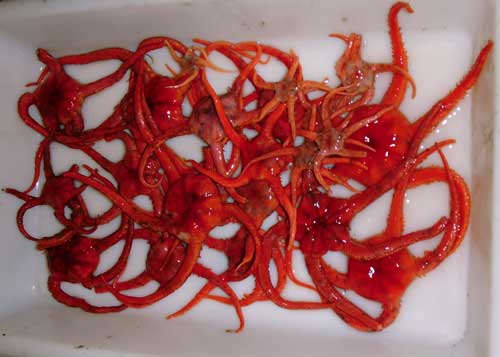
11.02.2013 (Monday). I wake up at 02:10 in the morning. I quickly eat a sandwich and go down. There, Freija Haucquier told me that there were problems with the Multicorer (the gear for sampling carots of sediment), which has to be replicated. So I woke up much too early. I knock to the door of the room of Marie and told her that she may sleep a little bit more. When the dredge comes up it is full of mud; only one amphipod. The Agassiz trawl has a distinctive fragrance of H2S and is full of black fluid mud. Yet, there are a lot of irregular sea urchins, gastropods, Notocrangons, and some fishes. Afterwards I go sleeping until 17:00. At 18:00, we have an extraordinary view on Andersson Island aka Rosamel Island. An unbelievable hood of clouds anchors at the top of this small volcanic island with huge cliffs all around. Then new Agassiz trawl and dredge. The OFOS video camera views indicate that we could expect a great catch. There is indeed a lot of organisms in the net. Almost no mud this time! A lot of ascidians (especially Molgula sp.) and huge red ophiurids. More than twenty giant Glyptonotus, including a male grasping its female. Several species of amphipods. We sort the sample of the trawl until middnight or a little later.

(Cédric)

The dredge was delayed and took place around 4 am. That gave me a little more time to recover. It wasn’t for much, finally, we just catched one common amphipod in the dredge and that’s it. This wasn’t a good sign for the Agassiz trawl, we were not very optimistic about the richness of this sampling site and what we could catch. Indeed, at first sight it looks quite lifeless. When we wash the mud, we can however find a good amount of sea urchins, decapods, but no amphipods. Disappointing sampling this morning, but it’ll give us the occasion to sleep before the last one. I sleep all the afternoon and wake up around 17h30. The Agassiz takes place in the evening, followed by a dredge. The catch is great this time. Almost no mud and a whole bunch of all kinds of organisms. Among the most impressive ones were those giant isopods that look like huge cockroaches, the Glyptonotus. We found tens of them, some about 15 cm long. Again 2 huge starfishes, one even bigger than the last one. And a lot of amphipods, however many belonging to the same species : Waldeckia obesa, Epimeria georgiana and Iphimediella rigida.  This catch keeps us working late again, around 4 am, but we’re happy we had a last good catch because the next days will be quiet again. There will be one last small week of krill survey before we start again with benthos sampling.

(Marie)


Andersson Island aka Rosamel Island.


Catch of the Agassiz trawl. 


Marie looking for amphipods.


Cleaning the scientists after work with muddy samples.


Male Glyptonotus grasping his female.


Glyptonotus are giant isopods.


Arcturid isopod (50 mm without the antennae).


Giant red ophiurids (leg span about 350 mm).

(Pictures by Cédric)


10.02.2013 - Giant isopod and hedgehog-like amphipod

10.02.2013 (Sunday). Still at Erebus and Terror Bay. I go late out of my bed in order to recover from the previous night and to prepare for the forthcoming one. In the morning no more dream view to a distant horizon: we are again into the fog. However this fog is not very thick and the day looks very bright. We do an Agassiz trawl and a Rauschert dredge in the afternoon. Catch of medium importance. We catch a huge Glyptonotus group antarcticus, a real monster of isopod. We caught two specimens of Echiniphimedia hodgsoni. These amphipods, which looks like hedgehogs, live and feed on sponges. 


 Glyptonotus sp. (120 mm) is a giant amongst isopods.


Echiniphimedia hodgsoni (30 mm) is an amphipod looking like an hedgehog.

We are informed that we will have to do another Rauschert dredge on 11.02.2013 ...at 02:30 in the morning. And it will be followed by an Agassiz trawl. So an awful night to come. We finish the sorting of the samples of today as soon as possible, so we can sleep a little bit. I am in my bed around 21:40.

(Cédric)

There will be 3 sampling sites at Erebus and Terror Bay. The first one is today in the afternoon, the other ones will follow quite quickly. Today’s catch wasn’t so big, so we can sleep early tonight, in order to be ready for the next dredge which is planned at 2:30 am! An Agassiz will follow at 6 am, so it’s a long night in perspective. 


(Marie)


A giant ten-legged Antarctic pycnogonid (sea spider). Picture by
Cédric

09.02.2013 - Mesmerizing icescape

09.02.2013  (Saturday). Saturday night fever: we are sorting and photographying the crustaceans of the Agassiz trawl until 04:00 in the morning. We go to bed completely exhausted. A number of amphipods not yet found during this cruise are discovered in the samples. Along with different amphipods, two Nebaliacea are found in the dredge. Several Serolis bouvieri in the trawl. I get a better mastership of my camera. Still the balance of the white is imperfect. 


Epimeria georgiana (up to 35 mm). This epimeriid amphipod is common near the tip of the Antarctic Peninsula and around the Antarctic islands, which prolongates it farther north, up to South Georgia.

Waldeckia obesa is another common and very characteristic amphipod of Antarctic seas.

I sleep until 11:30, just in time for lunch. The sea is open; no more ice except a tabular iceberg afar. There is a light haze, so the sky is white but luminous, we are steaming towards the Antarctic Sound, i.e. the straight between Joinville island and the tip of the Antarctic Peninsula. I am identifying the material collected yesterday. At 13:00 the sun shines through the haze. However  at 13:35 we dive in the mist and it becomes very dark. We see nothing when we enter the Antarctic sound; we just guess the occurence of an island, of which we can scarcely discern the basis through the fog. At 16:44, we suddently enter again into the ice. 17:30 alternance of ice and patches of open waters. During the evening the ship has to modify its course in order to avoid a huge (many kilometers long) tabular iceberg. As the fog has disappeared at that time, we could make nice pictures of it. Late in the evening, the sun is shining brightly on the southern part of the Antarctic Sound. Iceflows and icebergs are standing everywhere on a peaceful sea, with the mainland in background. The play of light and shadow looks as out of this world: we are in the realm of the ice fairy. This scenery is truly mesmerizing, never to forget.

(Cédric)

09.02.2013 (Saturday). I wake up around noon, hoping to enjoy the beautiful view of the Bransfield Sound, but the weather’s incredibly foggy and you can’t see anything further than maybe 20 meters. We’re in open water again. We’re steaming all day long to the next station and should arrive late in the evening. Later on, the fog dissolves a bit : it’s an ocean of snow now and we can see bits of mountains profiling in the horizon. We see the continent at last! It’s the end of the Sound, we’re going out. Later on, the fog is completely gone, everyone gathers on the deck to look at a huge tabular iceberg which forms a high wall in front of the ship, forcing us to change our trajectory in order to outline it. It’s really impressive, you can’t see the end of it. It looks like the continental ice-shelf and is probably a big piece of it which broke and drifted away.  The scenery begins to get even more beautiful as time goes by, we arrive in Erebus and Terror Bay and are surrounded by its islands. It’s the first time in this cruise we really could look at the land in a clear sky. With the sunny weather, the big icebergs and smaller drifting ice-plates, some high and rocky islands, some very elongated, rounder and white from the snow: an amazing view and feeling, once again. 

(Marie)

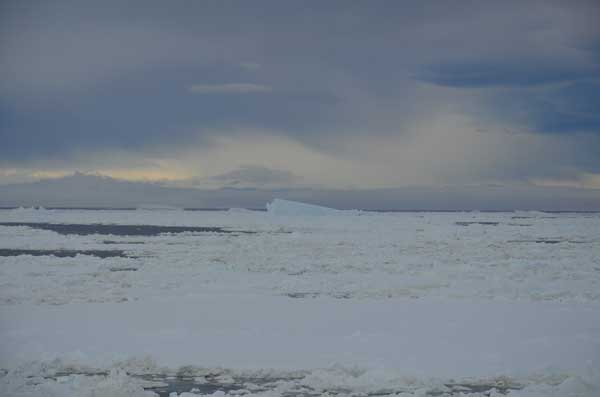
Ice and black sky.


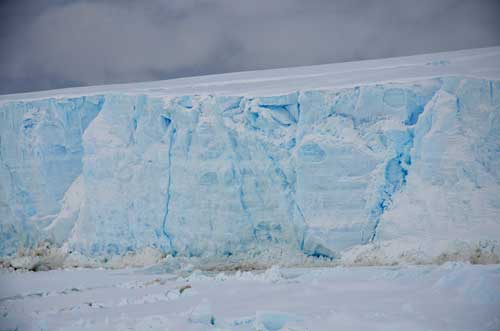
This iceberg is many kilometers long and it forced the Polartsern to modify her course.

Southern tip of the same iceberg.


Realm of the ice fairy.

(Pictures by Cédric)